

by Jason Williams
As fire season approaches, the DCNR Division of Forest Fire Protection contracts a fleet of specialized aircraft to provide rapid response to wildfires across Pennsylvania. These resources are strategically stationed to ensure timely support for ground crews, structure protection, and wildfire suppression.
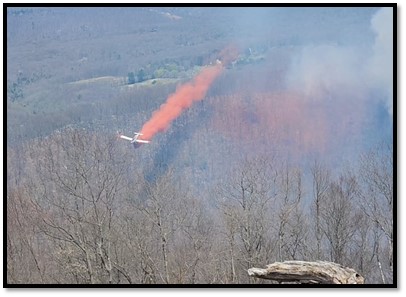
Two Air Tractor AT-802s, commonly called SEATs, are based at Hazleton Airport and Mid-State Airport. Each SEAT carries 800 gallons of fire retardant and can fly at speeds over 200 MPH. Thanks to skilled base staff, these aircraft can be reloaded in about five minutes, allowing for quick turnaround. SEATs are versatile tools in wildfire suppression. They can perform both initial and extended attacks with pinpoint accuracy and are particularly effective in the wildland/urban interface. SEATs also provide crews with valuable aerial observations, helping ground firefighters track fire behavior in real time. A unique feature is their ability to adjust drop levels depending on fuel type—from light grass to heavy timber—and even split loads to hit multiple targets in one run.
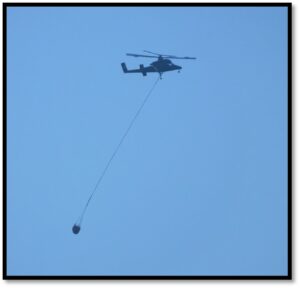
Pennsylvania also contracts three helicopters during fire season:
- Two Type III helicopters (90-gallon capacity each) based at Somerset County Airport and Wellsboro EMA Station
- One Type II helicopter (300-gallon capacity) based at Penn Forest Fire Control Station in Jim Thorpe
Helicopters play a different but equally important role. They can maneuver in areas SEATs cannot, making them ideal for hot-spotting, reconnaissance, fire mapping, and guiding resources into difficult terrain. Unlike SEATs, helicopters can reload from nearby water sources, reducing turnaround time on extended missions.
All aircraft are dispatched through Mid-State Tanker Base or Hazleton Tanker Base. When requesting aircraft, dispatchers need key information, including the fire’s location (latitude/longitude), nearest landmark or town, ground contact call sign, and any known hazards such as powerlines, smoke, or other aircraft. Once flight planning is complete, the dispatcher provides the requesting unit with an ETA and aircraft call sign.
Both SEATs and helicopters are valuable firefighting tools. SEATs bring volume and speed, dropping large amounts of retardant to slow the fire’s spread, while helicopters offer flexibility and precision, reaching difficult locations and providing immediate water drops. Together, they enhance Pennsylvania’s wildfire response and provide vital support to crews on the ground.