
Article republished with permission from
Willistown Conservation Trust’s The Sycamore Fall 2025
by Noah Gress, Director of Community Farm Program, photos by Blake Goll
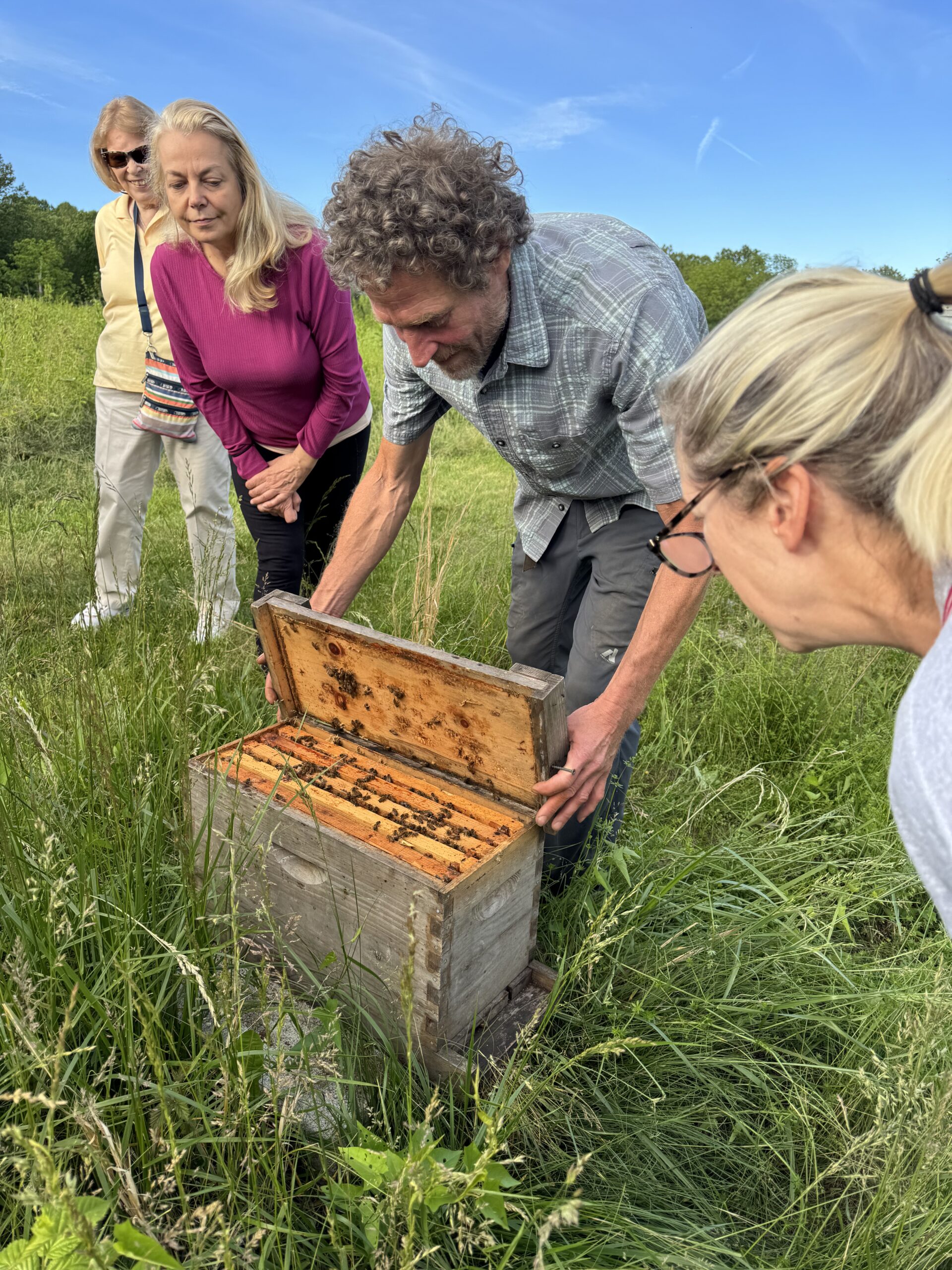
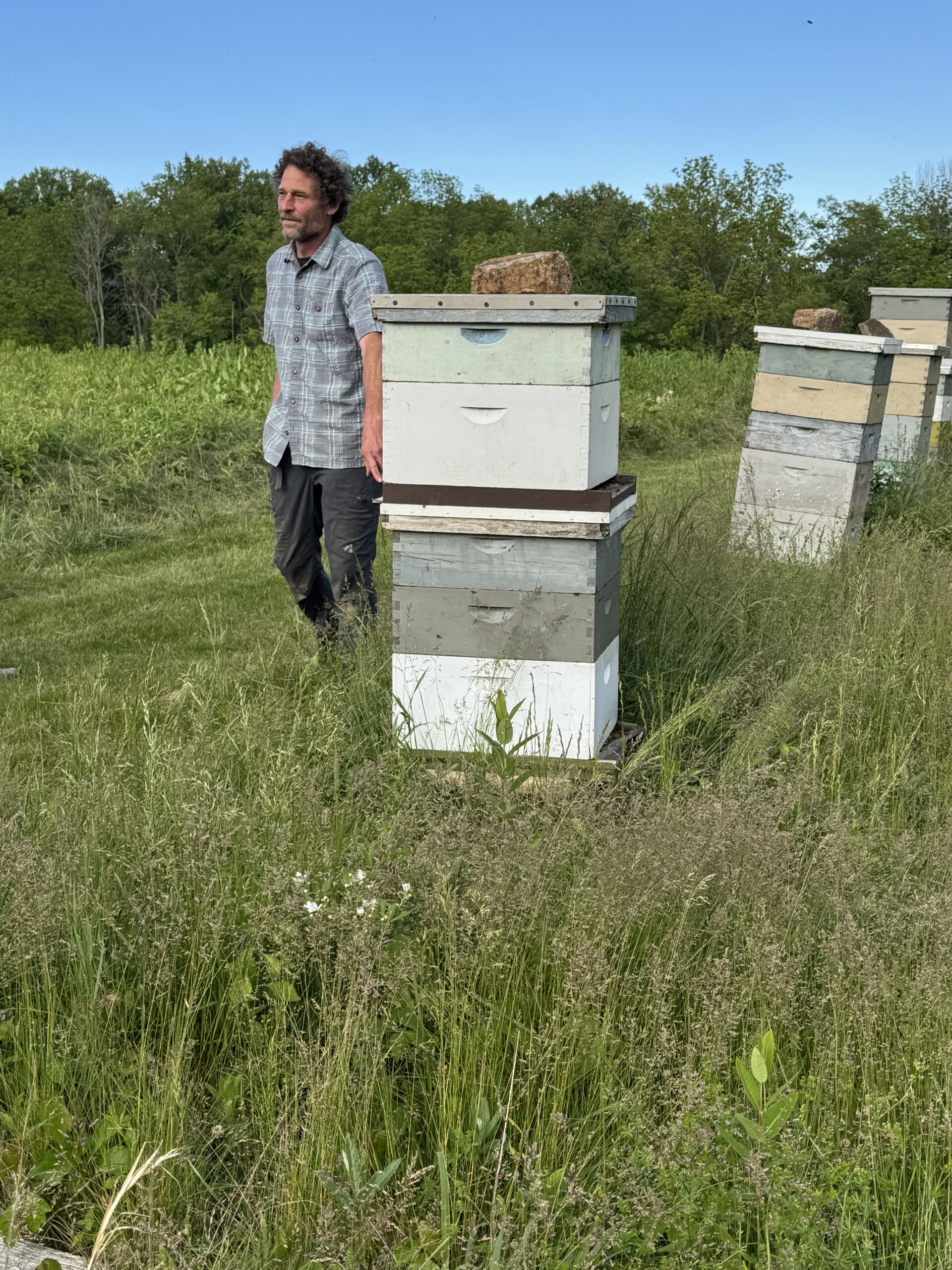
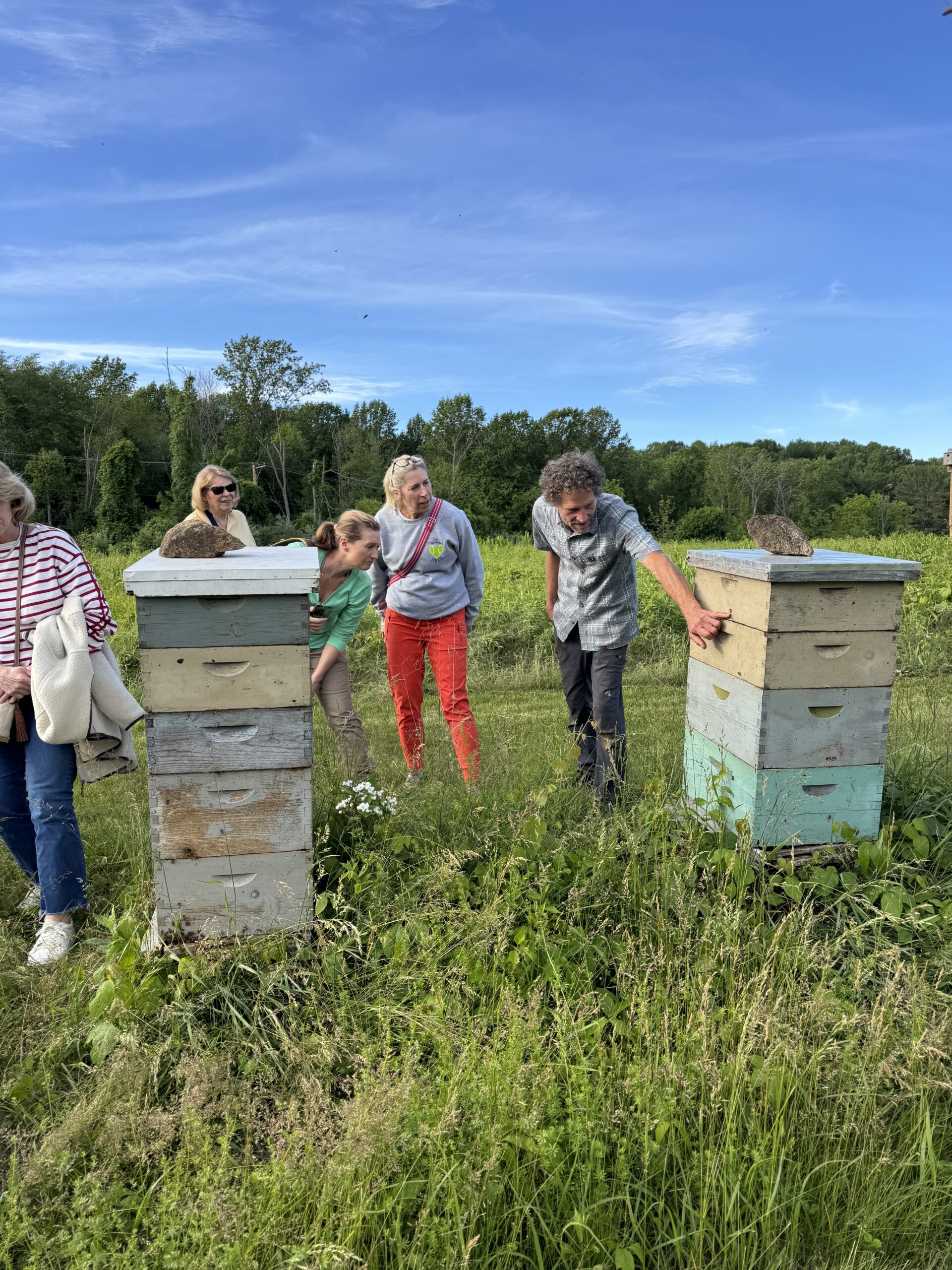
People often ask at Rushton Farm, “How are the bees?” reflecting their fascination. It might be the sweet elixir of honey that sparks this interest—satisfying a sweet tooth, evoking nostalgia, or awakening primal senses shared with early ancestors. Historically, honey was a rare and valuable commodity due to its sweetness and medicinal qualities. Evidence of early humans collecting honey is seen in cave paintings and hieroglyphics. The Egyptians were among the first to domesticate honeybees, using clay pots turned upside down for hives. When visitors see the wooden hives at Rushton Farm, they might sense some ancient magic or power in the bees. A hive filled with honey and bustling with nearly 60,000 bees can be truly awe-inspiring, each capable of producing up to 70 pounds of surplus honey during the spring nectar flow.
Some visitors are intrigued by the honeybee as she goes about her day. Most often, people encounter honeybees while admiring the many flowers blooming in fields and hedgerows; the bee moves methodically, almost dancing, around each flower, filling the pollen baskets on her hind legs. Look closely to see her dip her straw-like proboscis into a drop of nectar. The bee doesn’t eat the nectar but stores it in her honey crop. Once filled, she flies straight back to the hive. The work of a forager may take her as far as three miles from her home. Very rarely does she lose her way. Through dead reckoning and the sun’s position, the honeybee is an excellent navigator. A summer’s lifespan is about a month, and she brings home not much more honey than what clings to a fingertip dipped into a jar of honey. Now that the goldenrod is blooming, the hive’s foragers will make nearly a million trips to gather enough nectar to produce one pound of honey.
Honeybees collect more than just pollen and nectar; some are water enthusiasts. They can be seen by the hydrant gathering water to cool the hive. Others prefer mineral-rich water from a freshly watered seed flat. Sometimes, the Rushton Farm staff notice their bee coworkers drinking from the irrigation tubes that water the fields.
Some bees specialize in collecting tree sap and plant resins from essential oil-bearing plants. Bees then use these ingredients to craft a medicinal, glue-like substance called propolis. Honeybees use propolis to seal tiny cracks in their hive. The ingredients in propolis help keep the colony healthy. Historical records show that propolis was used during mummification in ancient Egypt. It is also used for mouth ailments and topically for skin conditions, infections, and inflammations.
When the sun begins to set and the day’s work ends, the honeybee returns to her hive. She is greeted by an elder bee who has retired from their more active job as a forager to become a guard bee. The guard bees gather at the entrance and welcome the homecoming forager to ensure she belongs to the hive. Once inside, the bees resume housekeeping chores and rest until dawn. The fact that bees spend the night in the hive has become the foundation of a thousand years of beekeeping.
We have been told about the importance of honeybees to our food supply. What makes them vital for maintaining it? Simply put, their home can be moved. The hive can be screened off and carried along as civilizations migrated. They were loaded onto wooden ships, modern container ships, wagons, and tractor trailers. As the fruits that sustain humanity bloomed, the hive was there to pollinate them. For millions of years, honeybees have played a crucial role in spreading pollen and other floral materials across the Earth. They ensured pollination, which became the foundation of the environment, and sparked the development of new species and varieties.
Despite the close intertwining of humanity and honeybees, bees often escape domestication and return to the wild. In spring, when the hive is filled with honey and the bees are running out of space to raise their young, the hive naturally develops the urge to split. This is how honeybees reproduce. The workers build special combs to raise new queen bees. The queen lays an egg in this “queen cup.” About two weeks later, the new queen will be fully developed and emerge to replace her predecessor as the hive’s leader. Just before the new queen matures completely, experienced foragers will push the queen, who led the colony through the previous winter, out of the hive’s entrance. Then, the queen and around 15,000 foragers fly off to start a new colony. Many people become inspired to take up beekeeping after seeing a swarm flying across a field.
When folks ask me, “How are the Bees?” I find it hard to know what to say. I usually reply that they are doing well or that they’re collecting more and more honey everyday. Inside, I think to myself, where to begin. To me, they are amazing, magical, and make me feel connected to nature and my ancestors. Sometimes I see them as a worthy adversary, especially when the hive is 60,000 bees strong and it’s the day I‘ve come for their honey. When Fred passed away, the bees, through the ancient ritual of “the telling of the bees,” helped me mourn and remember the good times we had when Fred would visit me while I was working with the bees.
From the first time I saw a swarm fly across a field I was farming, I knew I wanted to be a beekeeper. Wearing the hat of a beekeeper has allowed me to connect with all kinds of people in a way that reveals our shared humanity. We are all one people living in one world. The next time you visit Rushton Woods Preserve and see a bee, don’t hesitate to ask her how she is doing. You might be surprised by what you discover.



Read More
The Bees of Rushton Farm: A Pollinator Perspective on Sustainable Agriculture
About Willistown Conservation Trust
Approximately 4,000 acres in the Trust’s focal area remain vulnerable to development. It is our highest priority to work toward permanent preservation of these remaining lands.
Land protection begins with a willing land owner who agrees to permanently protect their land from development, while retaining ownership of the land. With highly qualified staff and technical support from our partners in the community, the Trust identifies strategic properties, works with landowners, prepares proposals, and negotiates agreements to protect those lands. Once the land is protected by a conservation easement, the Trust is legally bound to monitor and enforce compliance with the agreement, in perpetuity.