
By Jim Hyland
Last year, my son invited my wife and me to do a little trail hiking….in New York City. He told us about an old Native American path, 13 miles long, built by the Leni Lenape, that transects Manhattan from north to south. “Originally called Wickquasgeck, it is still in use today!” he said. He had my attention, and skepticism, and then added that Broadway Avenue was the original Native American path on the island, and it was preserved mostly in its original location despite the strict grid system that was built around and over it. The Dutch widened the path in the 1500’s and called it Brede weg, meaning “wide road”. In English, it became “Broadway”.
We had fun hiking the “trail” from way up town to the bottom tip of the island, by the Freedom Tower. Along the way, we literally saw thousands of people of world-wide ethnicities. Mid way, we passed through Times Square, now known as the crossroads of the world, and at the end, we drank beer in Fraunce’s Tavern, where General George Washington, in 1783, gave a farewell address to his military staff. He lived nearby in a mansion at One Broadway. And that brings us around to trail connectivity in Pennsylvania…
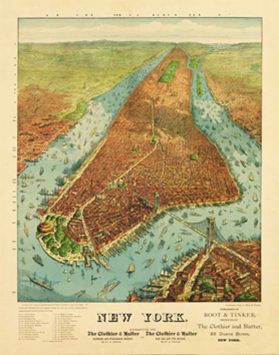
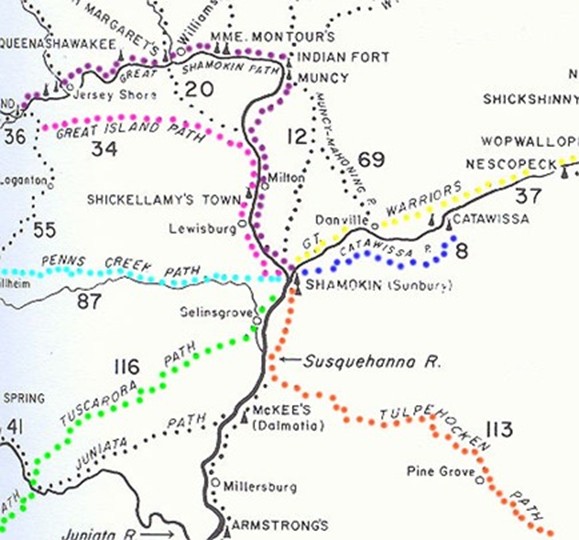
Back in the 1600s, when the Dutch West India Company set up a fur trading post on Manhattan Island, the Leni Lenape had created a then very old system of connected trails that crossed from Manhattan into present day New Jersey and into Pennsylvania. From there, one could travel to scores of native villages on many different paths leading in all directions. One option might be to head south on the Great Warrior path that followed the North Branch of the Susquehanna, and walk it to its terminus at Shamokin Village, now Sunbury.
Shamokin was located at the confluence of the North and West branches of the Susquehanna, and by 1700, the village had become the cultural crossroads and melting pot that New York City wouldn’t realize for another 150 years. Chief Shikellamy was in charge there. He was a wise Oneida man who welcomed people of many tribes from across Pennsylvania and New York. At Shamokin, they could live, trade, communicate and strategize. Historians believe he sensed the major cultural changes that the Europeans would bring, and he sought to unite his peoples. Five major trails converged at Shamokin: to the south was the Paxtang Path, it traveled the east shore of the Susquehanna through now Harrisburg. The name “Paxton” would become ubiquitous in the region. To the west was the Tuscarora Path to south central PA and Warm Spring (Berkeley), West Virgina. The Penns Creek Path headed west through Centre County. The Great Island Path led north to the Great Island at now Lock Haven, and then further west to Bald Eagle’s Nest, now Milesburg. The Great Shamokin Path also headed north along the West Branch to the Great Island, but also offered passage to the New York and Great Lakes region with right hand turns on the Wyalusing, Sheshequin, Tioga, Pine Creek, or Sinnemahoning Paths. Those paths would eventually become Routes 220, 87, 14, 15, 44/414-Pine Creek Rail Trail, and 120. The Great Warriors path followed the North Branch through the Wyoming Valley. Shamokin, like Broadway, was Pennsylvania’s “crossroads of the world”, except the known world to the native peoples was far smaller.
In 1756, during the French and Indian War, the native peoples had to abandon Shamokin and move west. Shikellamy was right. Nowadays we seek “trail connectivity.” It’s a hot topic, a buzzword, so to speak. And it is as important now as it obviously was to our Native Pennsylvanians who made our original trail connections. It’s interesting how a civilization evolves. We paved the original trails into roads and built railroads on them. Pennsylvania once had the greatest hiking trail connectivity possible, but we were driven by our desire to accommodate and protect immigrants from around the word, and so we enhanced connectivity with an entire nation on the paths previously chosen by the first Americans. And I think that desire still lives deep in us. We want to move simply across the land, following its natural contours. And we want to know that the trails we follow lead to other great places that we are welcome, and where different peoples live together in peace, like Shamokin, like Broadway.