
News article by Centre County Gazette posted 12 March 2026
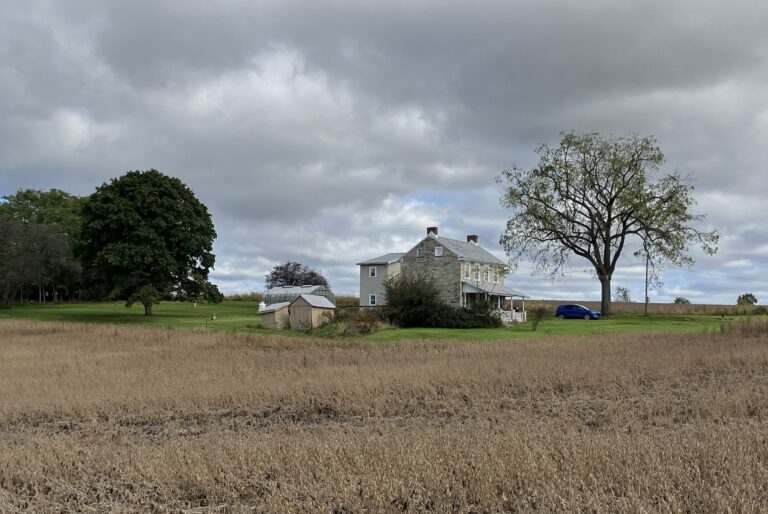
The historic house and fields on the Smith Farm, newly preserved through a conservation easement held by the Centre County Farmland Trust. The limestone house dates to the early 1800s and served as a stagecoach stop on the route between Lewisburg and Bellefonte. Photo courtesy of the Centre County Farmland Trust
Don and Esther Smith’s newly preserved farm in Spring Township will continue to help keep water clean, sequester carbon, and provide beautiful views and land suitable for agriculture through a conservation easement now held by the Centre County Farmland Trust.
Read Centre County Farmland Trust’s Smith Farm Preserved press release.
“It’s just a nice, perfect little place to live,” said Don Smith, whose wife, Esther, grew up on the land that was her family’s farm. The conservation easement on the Smiths’ 75 acres of fields and woodland was finalized with the Farmland Trust on Dec. 5, 2025.
The property is surrounded by development and the I-99 highway. The land is also adjacent to the Steeplechase residential sub-division and to the campus of the Central Pennsylvania Institute of Science and Technology Vocational School.
“It was such a joy to work with the Smiths and learn about the unique natural and historic features of their farm,” said Dan Guss, president of the Centre County Farmland Trust. “It feels good that we were able to help them accomplish their dream for the future of their land. There is also great satisfaction in knowing that the natural environment and the community will continue to benefit from the long-term preservation of this area.”
ClearWater Conservancy helped secure the conservation easement on the Smith farm by assisting with easement documents, mapping, and fieldwork.
“ClearWater’s help was vital to completing this complicated process in a timely and professional manner,” said Guss.
ClearWater’s Land Conservation Manager, Ryan Hamilton, commented: “Our partnership with Centre County Farmland Trust strengthens the community of land trusts preserving open space in central Pennsylvania and we’re proud this collaboration led to permanently protecting the Smith farm.”
A ‘nice little farm’
The Smiths have lived on the property for 30 years, tending their vegetable garden with hundreds of tomato and pepper plants. Their limestone house dates to the early 1800s and served as a stagecoach stop on the route between Lewisburg and Bellefonte.
Over the past several years, the Smiths have watched the landscape surrounding their farm change from rural to suburban, as developers have replaced houses, barns and out-buildings from nearby farms with many new houses. They did not want to see their historic house and barn demolished, nor their land bulldozed for development.
“It is a nice little farm. We did not want to see it go,” said Smith, who until 2008 worked for West Penn Power to maintain equipment in two dozen power substations in the area.
The Ault family for many years has grown corn, soybeans, hay and grains on about 50 acres leased from the Smiths, an arrangement expected to continue.
A long-held dream
The Farmland Trust, a non-profit, farmland-focused land trust, preserves land like the Smiths’ through a legally binding conservation easement that is tied to the property’s deed and prohibits development of the land, no matter who owns it in the future.
The Trust will continue to work with the Smiths and then future owners to safeguard the easement, ensuring that what happens on the land is consistent with the easement.
About 14 years ago, the Smiths decided they wanted the land to be preserved instead of developed. From then until the easement was finished in early December was “nerve-wracking” said Smith.
“When it did happen, we were very happy,” he said.
Prior to 2011, Esther’s mother had signed a sales option agreement with a developer for the sale to occur following her death. When that time came, said Smith, the developer stated a lower price, opening the door for re-negotiation and for the Smiths to retain the development rights.
Initially, they approached Centre County’s Purchase of Agricultural Conservation Easements program, which preserves agricultural land by compensating landowners for their development rights. The program ranks land based on criteria including soils and development pressure, and there is often a wait-list.
In summer 2024, after several years on the PACE wait-list, Elizabeth Pirrone-Brusse, Ag Preservation Coordinator, encouraged the Smiths to contact the Centre County Farmland Trust if they could donate the development rights — instead of receiving some money. The Trust does not pay landowners for the likely decrease in market value following a conservation easement prohibiting development on their land.
The Smiths sacrificed their valuable development rights to the property.
Benefitting Quality of Life in Centre County
The goals of the conservation easement are to benefit the community and greater good by improving the quality of surface water and groundwater on the protected property, as well as in nearby and downstream ecosystems, and by promoting biological diversity through the protection, enhancement, and restoration of natural habitats of flora and fauna, particularly native species.
These protections help ensure the long-term health, resilience, and ecological integrity of the land for present and future generations.
The 16 acres of protected woodland provides significant environmental benefits, as the trees help offset harmful by-products of burning fossil fuels, by storing carbon and trapping air-pollution particulates to help clean the air.
The new conservation easement also prevents the loss and depletion of soil on the land, protects scenic views visible from public roadways, and maintains land for agricultural use. The property delivers valuable ecosystem services by absorbing rainwater and sequestering carbon in plants and soil.
The Smiths plan to stay on the farm, continuing to grow and preserve vegetables and berries to enjoy giving to friends and for themselves, and produce wine made from strawberries and raspberries. They take pleasure in supporting a local farmer and beekeeper who grow crops and raise honey on the land.
About Centre County Farmland Trust
Preserve | Life needs land. Farmland, wetland, woodland, and scenic landscapes sustain life and spirit. We preserve privately owned working lands and undeveloped property in Centre and neighboring counties. We partner with landowners to preserve their land and assist them in stewardship of their land.
Protect | Land needs protection if it is to benefit life. Development pressure, climate change, economic fluctuations, population shifts—all can impair land’s vitality. We follow and enforce Land Trust Alliance Standards and Practices to maintain land’s capacity to support clean air and water, fresh food, wildlife habitat, and scenic beauty.
Engage | Communities of allies and supporters who care for land are essential to our work. We communicate to raise public awareness of and support for land’s importance. We collaborate with landscape artists to appreciate land’s forms as well as its functions. We actively engage farmers and their families, other private landowners, business owners, civic organizations, government agencies, financial donors, our members, staff, and volunteers in shared efforts to assure land’s future viability.
Benefit | Everybody benefits from land preservation and conservation. Individuals and families owning preserved land protect their land and might receive federal income tax credits. By placing a conservation easement on their property, owners protect its soils, waters, and woods. Owners set objectives for maintaining those irreplaceable assets. Preserving and protecting working land and open land is critical if present and future generations are to have the benefits of local food, family farms, treasured landscapes, regional ecologies, and economies.
About ClearWater Conservancy
The mission of ClearWater Conservancy is to conserve and restore our natural resources through land conservation, water resources stewardship, and environmental outreach across central Pennsylvania.