
Press release by Armstrong Trails shared 7 May 2026
A 130+ Mile Corridor Connecting Communities, Economies, and Opportunity
Across western Pennsylvania, a powerful regional rails to trails corridor is taking shape. By linking the Redbank Valley Trails, Armstrong Trails, Wynn & Clara Tredway Trail, and the Butler Freeport Community Trail, the emerging Brookville to Butler Route forms a continuous, non-motorized recreational trail system of more than 130 miles. This is more than a recreational asset. It is economic infrastructure, connecting former industrial towns, and rural communities in a way that attracts outside dollars, strengthens local businesses, and creates jobs both during construction and long after completion.
Mileage That Makes It Nationally Competitive
The corridor is built upon four established trail systems:
- Redbank Valley Trails – 51 miles – redbankvalleytrails.org – Facebook Page
- Armstrong Trails – 52.5 miles – armstrongtrails.org – Facebook Page
- Leechburg Towpath Trail – 1 mile
- Butler Freeport Community Trail – 21 miles – butlerfreeporttrail.org
- Wynn & Clara Tredway Trail – 6 miles
Total existing mileage: approximately 130 miles (depending on connection alignments and segments, more than 150 miles utilizing up & back spur lines), of non-motorized recreation, placing it among the longer rail-trail corridors in the United States.
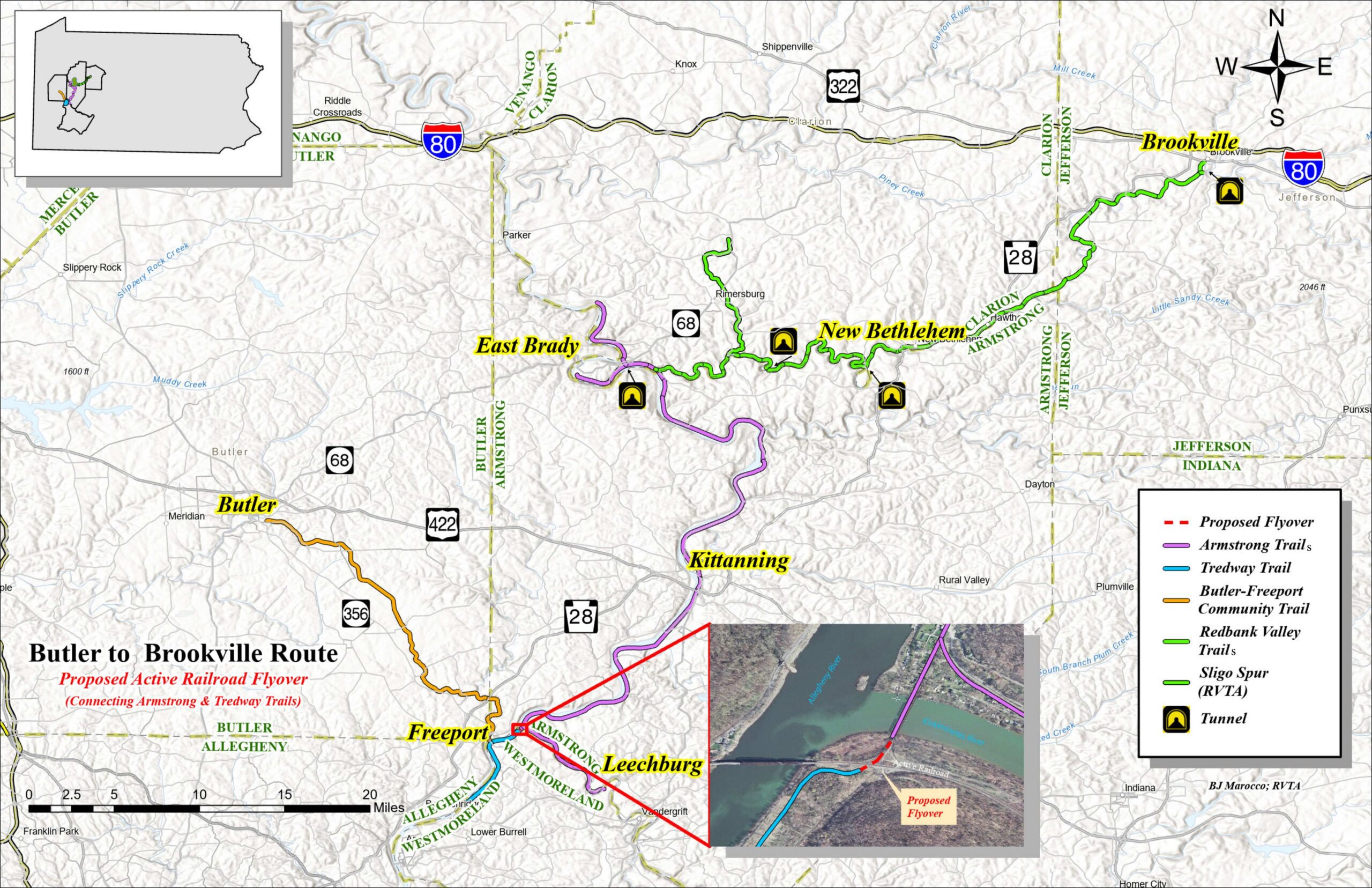
Butler to Brookville Route | Proposed active railroad flyover – Connecting Armstrong & Tredway Trails. Map Credit Armstrong Trails.
How Would It Rank Nationally?
According to Rails-to-Trails Conservancy (RTC) data, relatively few rail-trails in the United States exceed 100 continuous miles. When compared with nationally recognized long-distance trails, the Brookville to Butler Route would stand competitively.
Comparison of Major U.S. Rail-Trails*
*This list is comprised of rail-trails more than 100 miles long, where at least 90 percent of the trail is on a former railroad corridor. Source railstotrails.org
- Katy Trail State Park (Missouri) – 239 miles
- Palouse to Cascades States Park Trail (Washington) – 236 miles
- Cowboy Recreation and Nature Trail (Nebraska) – 203 miles
- Great Allegheny Passage (Maryland, Pennsylvania) – 153 miles
- Columbia Plateau Trail State Park (Washington) – 130 miles
- Paul Bunyan State Trail (Minnesota) – 122 miles
With mileage in this range, Brookville to Butler would likely rank among the top 6 longest rail-trail corridors in the country, depending on how continuity is measured.
Positioning matters. Trails exceeding 100 miles become destination routes, attracting multi-day riders and out-of-region visitors. “That kind of mileage changes the conversation,” said Chris
Ziegler, Executive Director of Armstrong Trails. “We’re receiving inquiries from riders (single and group riders) across the U.S. and Canada who are looking for their next long-distance
destination. Long-distance trail users are not accidental customers. They travel intentionally, and they spend intentionally. They WANT to spend locally.”
Economic Impact: Visitors Who Plan to Spend
Research on comparable long-distance trails consistently shows day users spend money on food, drinks, and small retail purchases, overnight users spend significantly more, on lodging, multiple meals, gear, and services, increased restaurant traffic, demand for lodging, expansion of retail hours, growth in outfitting and bike repair services, and seasonal employment opportunities.
Importantly, that spending is distributed mile by mile. Smaller towns benefit just as much as endpoints. Our communities have so much to offer, from paddling the Allegheny and Redbank Creek (to name a couple) to exploring our towns and enjoying local festivals, our region provides plenty of experiences that turn a trail stop into a weekend stay.
“Many parts of the route offer unique trail experiences that attract visitors interested in nature and history, including scenic views through undeveloped areas where flowers and wildlife can be seen, sculptural art and historic markers, with few road crossings” said Sandy Mateer, President of the Redbank Valley Trails Association. “Long-distance corridors like this strengthen our communities in multiple ways,” said Jamie Morabito, Allegheny Township Supervisor. “They support active transportation, improve health and wellness, and bring visitors who help our local businesses.”
From Former Industrial Towns to Trail Towns
The Brookville to Butler Route follows historic rail beds that once carried coal, timber, and industry. These same corridors can now carry economic opportunity. Communities can leverage historic architecture, riverfront settings, railroad heritage, and affordable storefront space. Trails do not replace industry, but diversify local economies in stable, sustainable ways. They create recurring visitation rather than one-time development.
Connecting Communities, Including Access to Services
This route links smaller communities with larger hubs, including towns that offer grocery access and expanded amenities. In some rural areas, food access is limited. A connected trail system safely links residents between towns, encourages pop-up markets and mobile vendors, makes new food businesses more viable, and supports expanded service hours. As visitation increases, services that benefit tourists also benefit locals.
“The Butler Freeport Community Trail was built by a community that believed in the power of trails,” Chris Ziegler, President, Butler Freeport Community Trail said. “Seeing our trail become part of a corridor of this scale shows what can happen when neighboring trail groups work together toward a shared vision.”
Construction Phase: Immediate Local Economic Impact
Before the first rider travels the full route, economic impact begins. Trail construction supports local contractors, engineering firms, excavation and grading crews, aggregate suppliers, equipment operators, and signage and fabrication vendors. When local hiring and local supplying is prioritized, construction wages circulate within the community, supporting restaurants, retailers, and service providers.
What Long-Distance Trails Need to Succeed
Building the corridor is only part of the equation. For the Brookville to Butler Route to function as a premier long-distance destination, communities must be trail-ready. “Many of our small towns are well positioned with the trails running right through towns placing trail heads where railroad stations historically were located”, said Sandy Mateer.
Trail-Friendly Businesses can increase revenue simply by signaling they welcome trail users with visible bike racks, water refill stations, restroom access, welcoming signage, and staff trained to answer trail-related questions Educated staff make a difference. Visitors remember when someone can tell them where to eat, where to stay, and what’s ahead on the route.
Places to Stay | Long-distance riders need overnight options spaced appropriately along the corridor: bed & breakfasts, campgrounds, short-term rentals, hostels or bunk-style lodging. Without lodging, riders pass through. With lodging, they stay and spend. Currently, this is our biggest need, we need to encourage growth and support our entrepreneurs.
Restaurants with Extended Hours | Trail users often arrive later in the day. Communities benefit when they offer evening dining hours, take-out options, grab-and-go meals, weekend breakfast service, and grocery stores within reasonable proximity. When food options close early, overnight economic impact declines.
Outfitters and Shuttle Services | As the route matures, additional services become viable bike repair and parts, rentals, gear sales, luggage shuttle services, and emergency pickup transportation. These services create local jobs and lower the barrier for first-time visitors.
Wayfinding and Visibility | Long-distance users must be able to navigate seamlessly consistent branding across counties, clear directional signage, well-marked trailheads, posted maps, and a strong online presence. A connected experience must feel connected.
A Regional Asset with Local Returns
A driver of small business growth, a job creator in construction and hospitality, a connector between rural communities and local basic needs, and a sustainable economic diversification
strategy.
And when that happens, the impact will not land in just one town. It will be shared, mile by mile across every community along the route.
Where We Are Now – and What Comes Next
Today, 100 miles of trail already exist between Brookville and Leechburg. The foundation is built. Communities are connected. Interest is growing. What stands between the Brookville to Butler Route, a fully continuous long-distance route is remarkably small, but mighty: 690 feet. The final 690-foot connection, called “Bridging the Gap at Kiski Junction,” has secured full design funding and is currently in the design phase, with construction funding applications pending, and has been designed as a Pennsylvania Top Five Trail Gap.
That short missing segment represents the final physical barrier to seamless connectivity. Once completed, the Brookville to Butler Route becomes a true uninterrupted corridor, a defining milestone that transforms our strong trail systems into one nationally competitive destination.
BUT WAIT! Why Stop There: Reaching into the PA Wilds and Beyond
While the Brookville to Butler Route is nearing full connectivity with just 690 feet remaining, the long-term opportunity extends even further. We hope Brookville to Butler is a short-term name. How about Butler to Brockway, Ridgway and beyond!
To the northeast, there is clear potential to strengthen connections into the PA Wilds region, linking to corridors such as:
- Five Bridges Trail
- Clarion-Little Toby Trail
- Additional regional trail assets beyond
These connections would expand the mileage, scenic diversity, and tourism draw of the corridor even further. The PA Wilds is already recognized as a destination for outdoor recreation, conservation landscapes, and rural tourism. Strengthening connections between the emerging Brookville to Butler corridor and the PA Wilds Loop trail network would intensive the impact to all.
What began as individual rail-trails in former industrial corridors now has the potential to anchor a much larger regional outdoor recreation network connecting small towns, river valleys, forest landscapes, and historic communities across western Pennsylvania. And the opportunity ahead is even larger than the mileage already on the ground.
Contact
Chris Ziegler, Executive Director, Armstrong Trails
724-968-6852 | armstrongtrails@gmail.com | armstrongtrails.org