
by Brian Plume
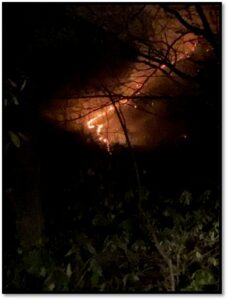
Packerton fire of 2025
Spring is here and wildland fire activity is once again at the forefront for the Bureau of Forestry and DCNR leadership. Statistically, wildfire occurrences are the highest during March, April, and May. There are several reasons for this: it’s warmer, relative humidity (moisture in the air) can decrease significantly, wind speeds tend to increase, forest fuels are cured from winter dormancy, and outdoor activity increases. Combining these weather factors lowers forest fuel moisture. It is not uncommon for cured grasses to be saturated from a morning rain shower and dry enough to burn in the afternoon.
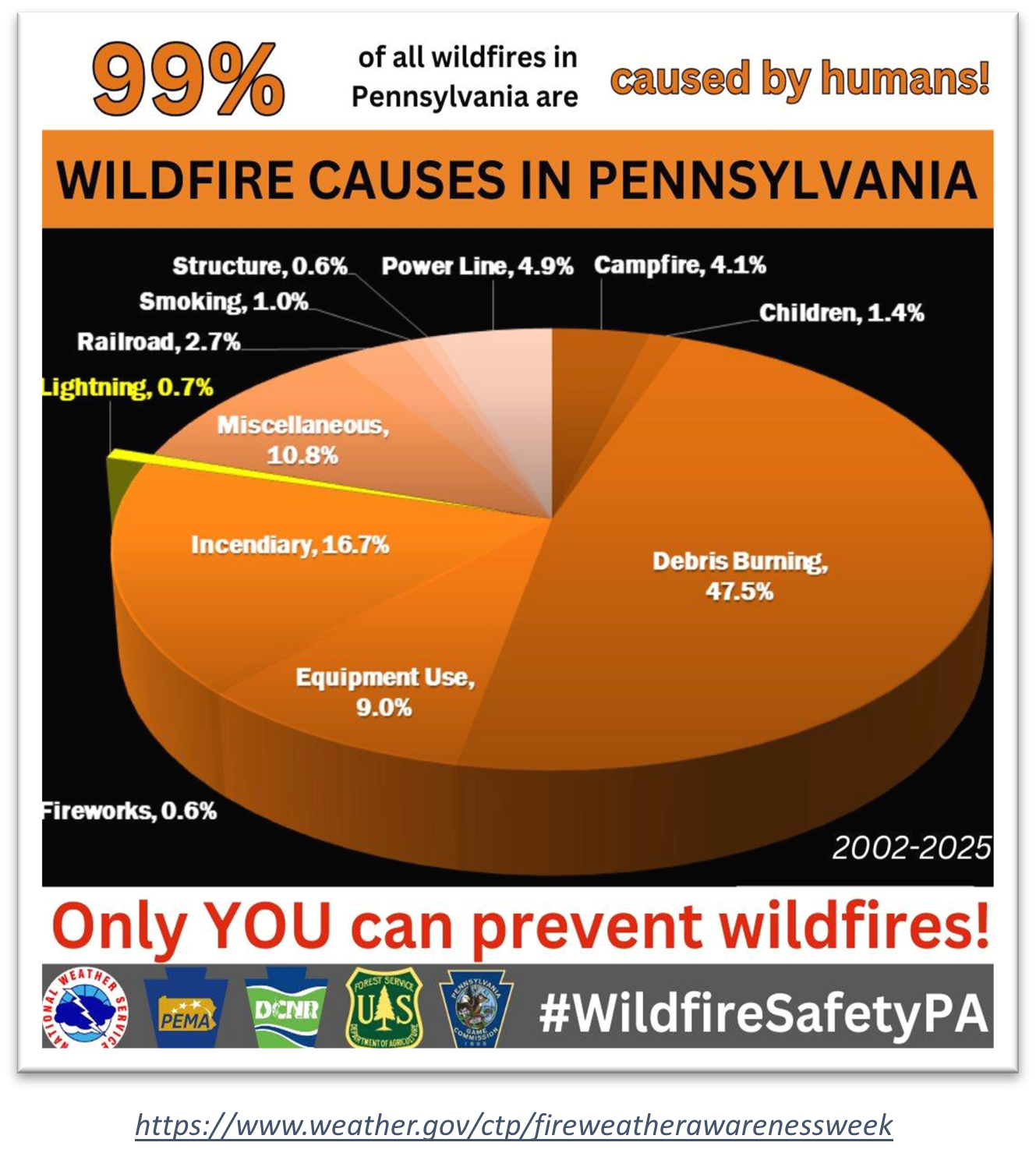
Nationally, nearly 9 out of 10 wildfires are caused by people. Wildfire causes are classified according to the ignition source: campfire, children, debris/outdoor burning, equipment use, fireworks, incendiary/arson, lightning, powerline, railroad, smoking, structure, and miscellaneous (a source not specifically defined within another category). In Pennsylvania, outdoor burning, arson, equipment use, and powerline are the “big” four causes.
Did you know that whoever causes a wildfire in Pennsylvania is responsible for any costs incurred by the Commonwealth, specifically the Bureau of Forestry, per statute?
Let’s take a closer look at incendiary (arson) wildfires. The simple definition is a wildfire deliberately or maliciously set with the intent to damage or defraud.
Why do people set arson fires? There are many motivations, including curiosity, revenge, heroism or thrill seeking, mental disorders, profit, and crime concealment, to name a few. It’s hard to understand or even rationalize why. What is easier to understand is the risk to public safety, loss of physical property, damage to the forest, socio-political effects, and the monetary costs of suppression and prosecution. I think it goes without saying that arson is a criminal offense.
It is not uncommon for arson fires to be small; however, some of the largest fires in Pennsylvania were caused by arson. Regardless of the size, they pose significant safety risks to firefighters and the public.
Over the past ten years, arson-caused wildfires accounted for over 10 percent of our fire occurrences, yet consumed nearly 50 percent of our burned acres. The largest wildfires in Pennsylvania over the past ten years were the result of maliciously set fires, including in 2016, the 8,000-acre “16 Mile” fire in the Poconos, in 2023, the 4,300-acre “Crystal Lake 6” fire just south of Wilkes-Barre, and in 2025, the 560-acre “Packerton” fire near Jim Thorpe.
If you see something, say something.