
By Suzanne Hartley
This year marks 250 years of the United States with celebrations around the country. Dickinson College’s Trout Gallery in Carlisle is celebrating America250 in a unique way with an art exhibition all about trees. “Branch: Trees in American Art” features artwork from nineteenth century to current day that “highlights how artists use trees to express national, cultural, spiritual, and personal identities in the United States”. The exhibition is free and open to public now through January 23, 2027, if you want to explore the connections between forestry, history, and art for yourself.
Throughout the exhibition are reminders of the role we play in shaping our landscapes. For example, the exhibition features nineteenth century paintings of lumber mills and landscapes that hint at the role of deforestation, agriculture, and the timber industry had on reshaping our landscapes. Other pieces, like the work of Mark Dion, explicitly highlight the impacts of introduced forest health pests, such as emerald ash borer, spongy moth, and hemlock wooly adelgid, have on our ecosystems.
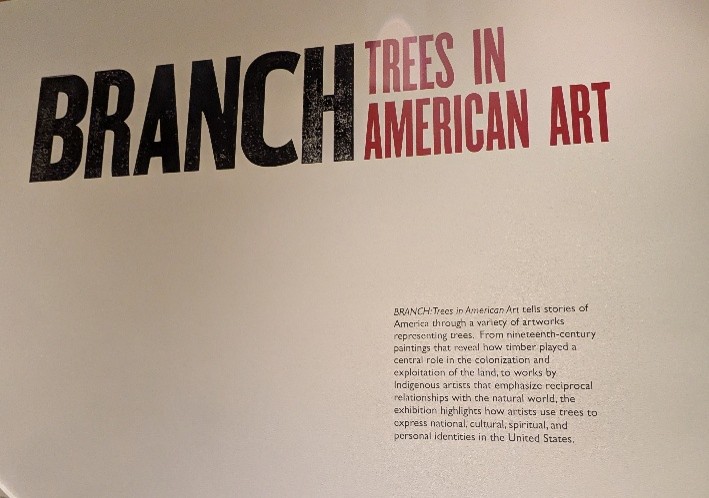
BRANCH: Trees in American Art tells stories of America through a variety of artworks representing trees. From nineteenth-century paintings that reveal how timber played a central role in the colonization and exploitation of the land, to works by Indigenous artists that emphasize reciprocal relationships with the natural world, the exhibition highlights how artists use trees to express national, cultural, spiritual, and personal identities in the United States.
There is even mention of our State Forests, as one of the pieces features botanical sketches labeled “Michaux Forest Trees” from a notebook on botany that belonged to James King Davison, a Dickinson alumnus. The notebook is from 1828, almost 80 years before the Department of Forestry was formed in 1901, and the first tracts of Michaux State Forest were purchased in 1902.
The exhibition also does not shy away from darker moments in our nation’s history, with a photograph of trees at the site of a civil war battleground by George N. Barnard. Another photograph, by Ken Gonzales-Day, is part of a project to document the history of racial violence in California by photographing over 350 trees from reported lynching sites.
The role of trees in culture and spirituality is celebrated by showcasing Ralph Waldo Emerson’s writing, Ansel Adam’s photography, and the artwork of Kay WalkingStick, an indigenous artist. Another featured indigenous artist, Lehuauakea, used charcoal from a 2020 Oregon wildfire to create a design on a kapa, a traditional Native Hawaiian barkcloth made from the bark of paper mulberry (Broussonetia papyrifera). It is interesting to see so many representations of trees in different mediums, from different parts of the country, across cultures, and spanning the last 250 years. The exhibition is a great reminder of how we are shaped by the ecosystems around us, and the opportunity we have to shape our ecosystems for the future.