
Reposted with permission from PA DCNR Linked In page posted 5 November 2025
By Cindy Adams Dunn, DCNR Secretary
In 1925, delegates gathered in Washington, D.C., to create what would become one of America’s greatest outdoor legacies — the Appalachian Trail (A.T.). One hundred years later, the 2,190-mile trail is a living corridor of recreation, conservation, and community connection.
The A.T. draws millions of visitors annually to the path that travels through 14 states.
Here in Pennsylvania, the A.T. spans more than 230 miles of ridge lines, forests, and river valleys. It crosses both public and private lands, including large stretches of state forest and park lands managed by the Pennsylvania Department of Conservation and Natural Resources (DCNR).
It also passes through small towns that have learned to turn their proximity to the trail into opportunity – perhaps none more clearly than Duncannon, at the confluence of the Susquehanna and Juniata rivers.

First Lady Lori Shapiro and DCNR Secretary Cindy Adams Dunn have hiked portions of the Appalachian Trail together.
The A.T. on Pennsylvania’s Landscape
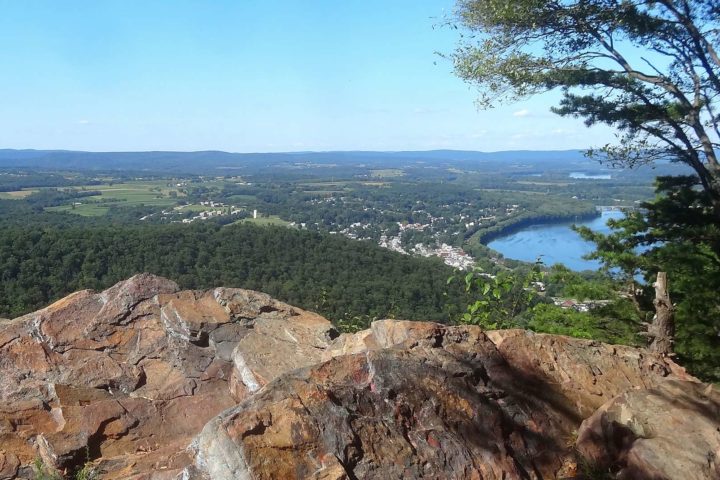
The A.T. winds across Pennsylvania’s Kittatinny Ridge, through Weiser State Forest, and over Peters Mountain, where hikers see sweeping views of the Susquehanna River valley from Hawk Rock near Duncannon. Historic transportation corridors and landscapes shaped by human history also are found along the way.
I have section-hiked all of the miles of the A.T. in Pennsylvania (and some in other states). You can follow First Lady Lori Shapiro on Facebook to learn about her goal to do the entire trail in the Commonwealth as well!
DCNR’s stewardship plays a key role in protecting these landscapes. The department:
- Manages public lands through which the A.T. passes, ensuring conservation, access, and maintenance
- Funds land protection to secure key parcels along and near the A.T.—such as recent acquisitions on Peters Mountain adjacent to DCNR forest lands
- Designates Conservation Landscapes, including the Kittatinny Ridge Conservation Landscape, linking natural, recreational, and cultural resources across counties
- Supports volunteer stewardship, partnering with the Appalachian Trail Conservancy (ATC), local trail clubs, and organizations for maintenance and training
These efforts ensure that Pennsylvania’s stretch of the A.T. balances ecological protection with community benefit.

Duncannon is located in Perry County (Central PA).
Duncannon: A Trail Town Case Study
Nestled at the confluence of the Susquehanna and Juniata Rivers, Duncannon is a small Perry County borough with a big distinction — the Appalachian Trail runs right through its downtown. Strolling along Market Street, you’re literally walking the A.T., an experience that shapes the town’s character, culture, and economy.
To complete my final leg of hiking all 229 miles of the A.T. in Pennsylvania, I chose to have family members meet me for the one-mile stretch through Duncannon because of the welcoming feel of the pocket parks, ice cream shops, businesses, and residents in the community.
DCNR staff and organizations involved in our Conservation Landscape effort recently visited with Duncannon officials and businesses.
Duncannon faces some economic headwinds like fewer industries and shifting populations.
With its striking geography, historic architecture, and deep-rooted connection to the trail, the town is focusing on how connections between outdoor recreation and local culture can create economic opportunity and help Duncannon thrive.
- Official A.T. Community Designation: Recognition by the Appalachian Trail Conservancy (ATC) brings visibility, credibility, and marketing reach.
- Local Business Support: Hikers and visitors fuel spending at small businesses—restaurants, lodging, gear shops, and the iconic Doyle Hotel. hikers, day‑visitors and overnight guests stop in the borough for lodging, meals, resupply, shuttle services and gear support.
- Community Events: Duncannon hosts or participates in trail‑related festivals, hikes, craft events, and volunteer trail maintenance—connecting residents with the trail, boosting foot traffic in town, and reinforcing local pride.
- Revitalization through Heritage: Historic sites like the 1788 Clarks Ferry Tavern are being restored as gateways and interpretive stops for hikers and tourists. The trail corridor helps justify investment in signage, pedestrian access, parking and visitor services.

During a recent tour Duncannon Mayor Rick Kneff said the town uses its trail access and features like views from Hawk Rock ridge, river confluence, and historic downtown as part of its branding and economic renewal strategy.

Co-owner Michael Lindgren of Lindgren Brewery said efforts are underway to make Duncannon a destination for A.T. section hikers, create more trail loops and connectors, and pull people from Hawk Rock into the downtown.

The Doyle Hotel, popular as a stop with a bed for A.T. hikers, is being renovated to include en suite bathrooms with the rooms.
How DCNR Supports Trail Towns Like Duncannon
While Duncannon itself lies outside state forest boundaries, the nearby state lands and DCNR investments directly benefit the town and its outdoor economy:
- Trail Infrastructure: DCNR helps fund parking areas, signage, and access points on and near the A.T., making it easier for hikers to connect with local towns.
- Grant Funding: Through the Community Conservation Partnerships Program (C2P2) and related trail grants, DCNR provides funding for planning, land acquisition, and trail development.
- Trail Gap Closures: DCNR’s Land and Water Trail Network Strategic Plan (2025–2029) prioritizes connecting communities like Duncannon to major trails and greenways.
- Example Investment: In 2024, DCNR awarded the Appalachian Trail Conservancy a $40,000 grant for a feasibility study to improve the Trail crossing between Berks and Schuylkill Counties—one of several A.T.-related projects supported statewide.
- Broader Commitment: In its 2025 funding round, the Shapiro Administration announced more than $50 million in recreation and conservation grants, including about $10 million for trail projects across Pennsylvania.
These programs help ensure that the A.T. and the communities it touches remain vibrant, sustainable, and connected.
Looking Ahead: A Trail Town Vision for Pennsylvania
As the A.T. marks its centennial year, the next phase emphasizes not just preservation of the trail’s rugged backbone, but deeper integration with the people and places along its length. For Pennsylvania towns this presents opportunity:
- Using the “A.T. Community” badge to promote tourism, local business, lodging and outdoor‑recreation economy.
- Tying into conservation and resilience grants (for example, the ATC’s Pennsylvania Community Conservation Collaborative offers planning support and technical assistance) to strengthen both environment and economy.
- Building trailside amenities, interpretive centers, family‑friendly activities (like Duncannon’s craft‑stations, hiking‐events) to broaden appeal beyond the hardcore thru‑hiker market.
- Telling the story: every Trail Town has a history, natural feature, vantage point (in Duncannon: Hawk Rock, confluence of rivers, old taverns, manufacturing heritage) and leveraging that to make the place distinctive for visitors.
As the Centennial of the A.T. winds down, in Pennsylvania we celebrate not just the ridge‑lines and vistas, but the towns like Duncannon that make the journey possible and bring the trail into daily life.

A mural of the path of the Appalachian Trail.