

by Dave Scamardella
The Franklin tree (Franklinia alatamaha) is one of the rarest, most mysterious, and historically significant trees in the world, celebrated for its complete extinction in the wild and its survival solely through human cultivation.
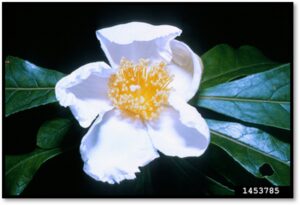
Photo by Sturgis McKeever, Georgia Southern University, Bugwood.org
The saga of the Franklin tree began in October 1765, when noted American botanist John Bartram and his son William discovered a tiny, two to three-acre grove of unusual shrubs along Georgia’s Altamaha River. Entranced by its beauty, William Bartram collected seeds from the grove in 1777, bringing them back to the family nursery in Philadelphia to propagate. William named the genus Franklinia to honor his father’s close friend, Benjamin Franklin, and gave it the species name Alatamaha after the river where it was found. By 1803, just a few decades after its discovery, the Franklin tree completely vanished from its native Georgia habitat, never to be seen in the wild again.
Explanations for its rapid extinction range from over-collection by early nurserymen to localized flooding, fires, or a fungal pathogen introduced by nearby cotton plantations. Because of this, every single Franklin tree alive today across the globe is a direct descendant of the seeds rescued by the Bartrams.
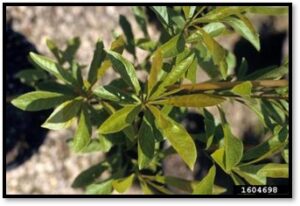
Photo by John Ruter, University of Georgia, Bugwood.org
A member of the tea family, the Franklin tree is a highly prized ornamental plant known for its striking, multi-season appeal. When most trees have finished flowering, the Franklin tree bursts into life from late August through October. It produces cup-shaped, five-petaled white blossoms with prominent yolk-yellow centers that carry a sweet scent reminiscent of orange blossoms. In autumn, its glossy green leaves shift to a brilliant, deep ruby-red. Because it blooms so late, it creates a stunning visual contrast with bright white flowers and a backdrop of red foliage.
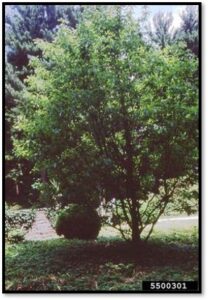
Photo by T. Davis Sydnor, The Ohio State University, Bugwood.org
While the tree is still grown at Bartram’s Garden in Philadelphia, which is open to the public dawn to dusk every day, one might be surprised to learn of a beautifully maintained specimen right outside of the front door of the Weiser State Forest District office. Located in Columbia County off Route 42 between Aristes and Numidia, this public specimen serves as an educational centerpiece for the Bureau of Forestry. It perfectly highlights DCNR’s core mission: to conserve and sustain Pennsylvania’s natural resources for present and future generations’ use and enjoyment, while also sharing the deep historical legacy of Pennsylvania’s early botanists with the public.
For more information: