


by Andrew Baker
In the December 1983 issue of Deer and Deer Hunting magazine, a prominent article detailed the opening day of the 1982 antlered deer season through the eyes of a guest at “Camp Harmony”, a state forest leased campsite in the north block of Tuscarora State Forest. As the original article shows, many of these camps have a long, and sometimes colorful, history. All have stories that evoke a sense of nostalgia of the days of deer hunting in the “big woods”, when opening day was a Monday and red and black striped Woolrich clothing was the norm.
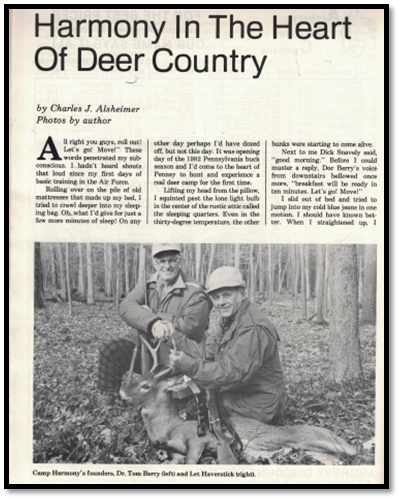
Those familiar with the nuances of leased camp administration may find the article’s references to the indoor toilet and bathroom to be odd since most leased camps still do not have any indoor plumbing. This is one of the few camps on Tuscarora State Forest that had a “grandfathered” septic system and water supplied through a pump house. The author may have been shocked to find out that pretty much every other person using a state forest leased camp would have been making an early morning journey to the outhouse through the ice and would not have enjoyed a hot shower at the end of the day.
Unlike the anomaly of indoor hot and cold plumbing, Camp Harmony came about much the same way other hunting camps were established: a few men pursuing a lifelong dream of owning a camp in prime deer country. Camp Harmony became a reality in 1957 when three Lancaster area friends built the cabin that still stands today. Over 80 miles from their homes in Lancaster County, one fellow had spent summers in his youth visiting his uncle, a game warden here in Mifflin County. The highlighted article describes the camp location:
Situated fifteen miles west of Mifflintown, the camp is located in the heart of Licking Creek Valley – miles from the nearest electrical hookup. Just driving to the camp makes one’s heartbeat increase, for the entire fifteen-mile trip from Mifflintown to Licking Creek reminds you that this is whitetail country, the kind of country dreams are made of. The paved roads and any sign of open country end as you near the first sign announcing the more than 6,500-acre Tuscarora State Game Lands. From that point on tradition begins.
The end of that description demonstrates that Pennsylvanians have often been misinformed about the differences between state-managed lands.
The author of the 1983 article asked of the camp founders how it got its name “Camp Harmony.” He was told:
Originally…because we all agreed there would never be any disharmony here. And you know, in all the twenty-five years there’s never been anything close to a disagreement. Of course, we don’t allow alcoholic beverages, radios, or TVs in camp and if a guy wants to use a telephone, it’s fifteen miles down the road.
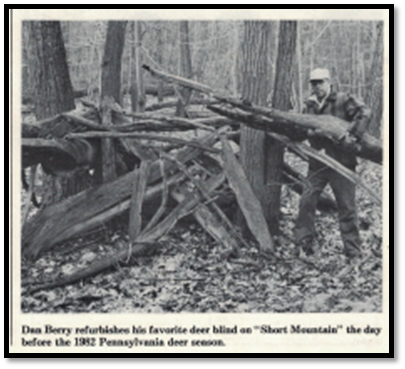
Of course, these days that telephone is carried around in your pocket, but completing a call is still challenging in many parts of our state forests.
That year, like many before and since, opening day of deer rifle season started early (4:30am with reveille and a family-style breakfast of bacon and eggs):
Around the breakfast table sat doctors, corporate executives, factory workers, a minister, and a photographer. And nobody talked about politics, the economy, or their families. On this day it was a different kind of business – white-tailed deer business. Weather, hunting techniques, and the stands they’d be hunting dominated the chitchat around the table.
Despite an ice storm the night before, all eight hunters reached their hunting spot by first light at 7:00am. Some even had a successful harvest by day’s end: Though nearly all of us were tired, supper was joyous. Everyone had a story to tell.
Today, the State Forest Leased Camp Program still provides a natural escape for lessees and their guests. Some have more modern conveniences (electricity) but many are still without indoor plumbing while cell phone and internet service are even less likely. And while the purpose of many of these nearly 4,400 (400 on state park land) camps continues to be the pursuit of hunting and fishing, many have become family escapes. They remain an oasis where the fast-paced urban environment can be left behind to experience the camaraderie and dialogue of camp. May attendees never lose that connection to the natural resources so steadfastly protected by DCNR.
Best of luck to all the hunters out there!
Read original December 1983 issue here: Harmony in Heart of Deer Country