
by Carissa Schnabel and Suzanne Hartley
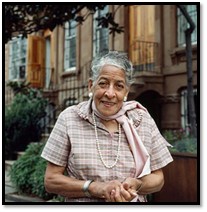
Hattie Carthan. (image courtesy of the Hattie Carthan Community Garden)
Without the passionate individuals who care about their connection to the natural world and their communities, our forests, towns, and cities might look vastly different. In some cases, one person and one tree can ignite change that inspires and creates a lasting legacy.
This is true for Hattie Carthan, the Tree Lady of Brooklyn, who helped transform her community and empower her fellow African American community members in ways that are still visible today. Born in 1900, Hattie moved from Virginia to Brooklyn’s Bed Stuyvesant neighborhood in 1953. After noticing a decline in trees in her neighborhood, she formed the Tompkins & Throop Block Association with seven other residents in 1964. Together, they sold plates of food to raise money to plant four trees. This seemingly humble effort grew to influencing the city’s park department to match trees that they planted and grew again to the Stuyvesant Beautification Association that included 100 block associations that planted over 1500 trees across the Bed Stuyvesant neighborhood.
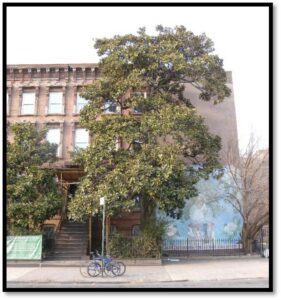
Magnolia Tree Earth Center with the Magnolia Tree and a mural honoring Hattie Carthan in 2009. (photo by Jim Henderson, Wikimedia Commons.)
Hattie’s efforts did not stop there. In the Bed Stuyvesant neighborhood stood a climactic oddity of a Southern Magnolia, Magnolia grandiflora. The 40-foot tree had arrived in Brooklyn by ship and was planted by a local resident in 1885. A southern transplant like Hattie, it was able to survive New York’s colder climate because of the warmth of three adjacent Brownstone buildings. With proposed changes to the neighborhood looming, both the tree and the brownstones were at risk of being demolished. In 1968, Hattie began campaigning to save the tree and brownstones, and in 1971 the tree became a living city landmark. She also campaigned to save the brownstones from demolition to create the non-profit Magnolia Tree Earth Center in 1972, where she worked to provide environmental education and community empowerment through teaching tree care and gardening skills.
Her efforts earned her the name the “Tree Lady of Brooklyn”, and she was honored with a distinguished service medal from the city. Hattie Carthan died in Bedford-Stuyvesant, the neighborhood she transformed in April,1984, at the age of 83.
Today, the magnolia tree remains the only living city landmark (a second tree designated a such died in 1998). The Magnolia Tree Earth Center and Hattie Carthan Community Garden have continued to carry on Hattie’s legacy through environmental education and community empowerment programs. Hattie remains an inspiration to the idea that small efforts can grow to have large and lasting impact.
“We’ve already lost too many trees, houses and people
…your community– you owe something to it. I didn’t care to run.”
– Hattie Carthan
Resources to learn more:
- Historical Sign Listings : NYC Parks | New York City Parks and Recreation
- Brooklyn Botanical Garden
- Hattie Carthan | The New York Preservation Archive Project
- A Tree Is Born in Brooklyn | Magnolia Tree Earth Center of Bed-Stuy
- Hattie “The Tree Lady of Brooklyn” Carthan | Brooklyn Public Library
- Hattie Carthan | NYPAP
- The Tree Lady of Brooklyn – How Hattie Carthan Planted 1500 Trees