

by Emily Shosh
Unlike many outdoor enthusiasts in Pennsylvania, I never grew up hunting. But as fate would have it, an unexpected interest in trap shooting led to a grouse and upland hunting obsession, later leading to small game, and finally, big game and deer hunting. In five years I’ve mostly self-taught, aka, hiked with a shotgun in hand and came home empty handed but happy to observe and learn. Only in the last year has it started to click. This season’s first hunt for squirrel hopefully set the stage for a very happy 2025-2026 season.
On a Saturday morning I set out with my boyfriend, Bill, back home near Ulysses, PA (Potter County) on our first ever hunt together. He had not been out for small game in years, and I never had luck with squirrel, so the excitement was palpable. We heard a few ‘barking’ from a distance on our walk into the wood line, then found an oak to sit under and watched the show unfurl.
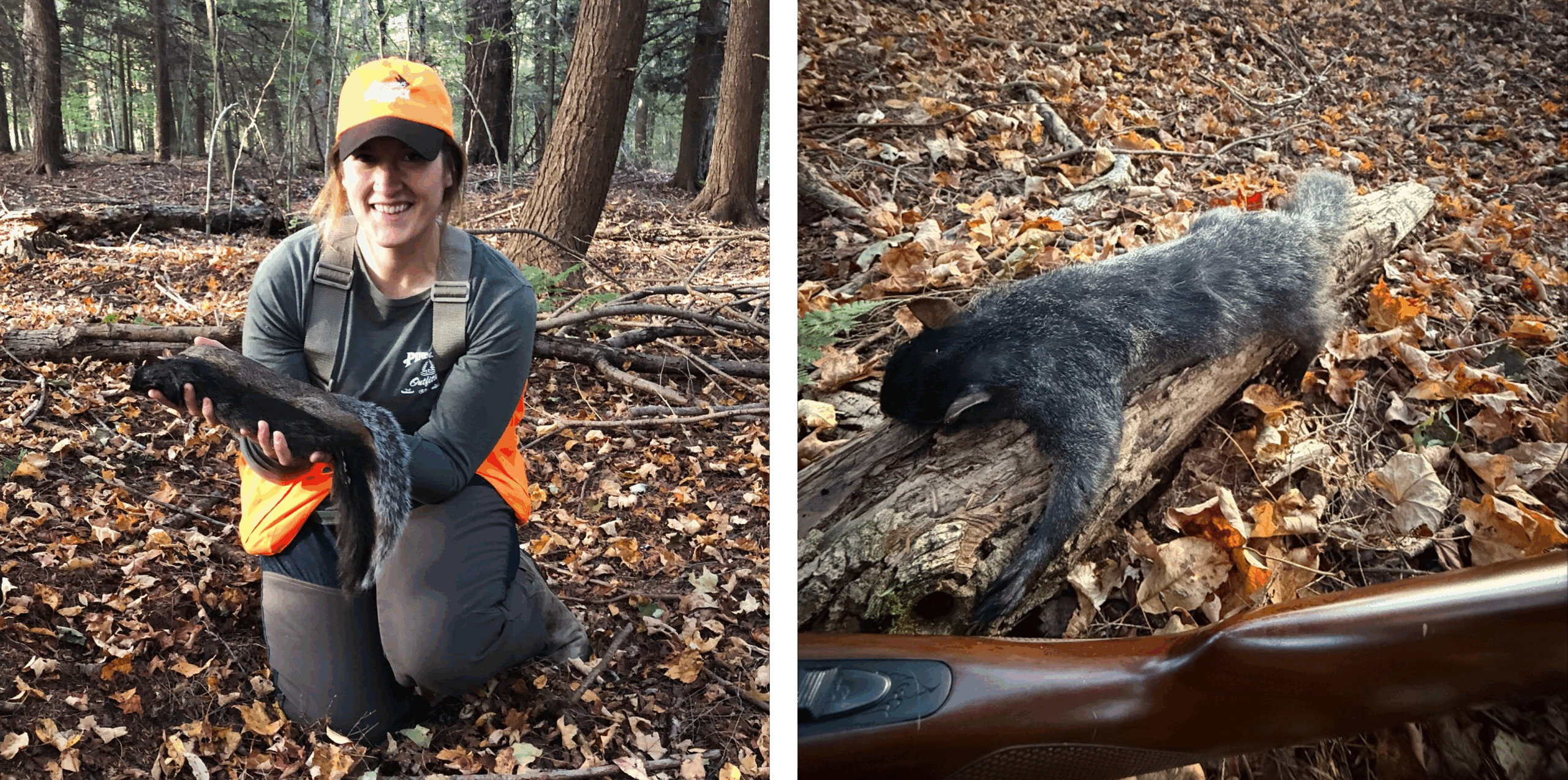
First, a large male came down a tree and towards us – my first ever gray squirrel harvest, which practically leaped into my lap within 10 minutes. We were beaming. Shortly after, another came bounding across a log in front of me. The light coming in made it seem like a smaller red squirrel, so I hesitated to take the shot, but with one last opportune moment, pulled the trigger.
Thirty minutes after a lull in activity, we trotted over to collect each. I was anxious to see their size and coat condition. The meat we planned on freezing for later and the fur I wanted for fly tying materials. The first harvest had a gorgeous tail, and I began to picture all the streamers that would come of it – bringing in bass, steelhead, and trout to net. The second took us a moment to find and when we did, we were taken aback – not red but a black phase gray squirrel! It was smaller and had a sparse tail, but it felt like Christmas morning, regardless.
Although black or ‘melanistic’ squirrels are often sought after, they are not all that rare in Pennsylvania according to the game commission. While not considered rare, they do occur most commonly in northcentral counties and tend to be a bit sparser downstate. They result from a variant pigment gene in both gray and fox squirrel. The black coat is thought to offer an edge in camouflage, especially in conifers. The coat is also thought to offer more pronounced heat absorption and thus a higher cold tolerance.
Among gray squirrels, a gray mating pair cannot produce black offspring, since the parents have two copies of gray pigment gene. Black squirrels either have one or two copies, so their litters may vary in color. If a squirrel has two black copies it will be jet black, but if it has one black and one gray gene it may be brown/black. Approximately nine percent of all melanistic squirrels are jet black, as per a 2017 study in Ohio.
While the hunt was unique, all honest hunters know that ‘rarity’ is not a requirement in having a good experience. Hunting is much more than taking ‘trophies’, harvesting meat, furs, feathers – It’s a unique way to truly know the forest and make memories. I’m incredibly thankful to have the time and company for it. God willing, the freezer and the heart will continue to fill.