


by Jamie Withers
Bilger’s Rocks is a tourist destination named for its original settler, a German immigrant named Jacob Bilger (1783-1863).
By VitaleBaby – Own work, Public Domain, https://commons.wikimedia.org/w/index.php?curid=80243961
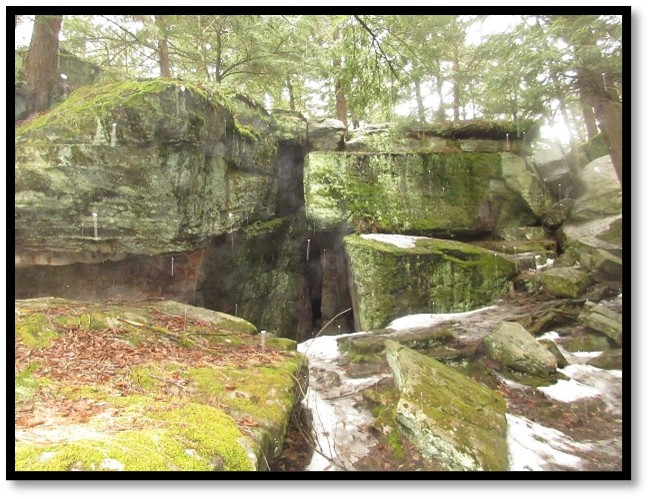
The rocks’ formation started during the Pennsylvanian Period more than 300 million years ago with buildups of sand grains deposited by streams. Over time, a thick layer of sand grains accumulated and were buried by later deposits of limestones and shales. Burial pressure and time formed these layers of sediments into rock, a process known as lithification. These sand grains made up the approximately 20-foot-thick body of rock geologists call the Homewood Sandstone, one part of a larger group of rocks incorporated into the Pottsville Formation.
During the continental collisions that formed the supercontinent Pangaea nearly 300 million years ago, mountain-building tectonic forces pushed these layers upward and folded them to form the Appalachian Mountains. These forces, even when applied over millions of years, cause stress fracturing of the thick rock layers as they get bent and folded into new contortions. These fractures are called joints.

By VitaleBaby – Own work, Public Domain, https://commons.wikimedia.org/w/index.php?curid=80243984
It is estimated that these early Appalachian Mountains were five miles high – a height that would dwarf today’s Mount Everest. What the Earth’s forces thrust upward, gravity works harder to break back down. Since the Appalachians’ formation, erosion by wind, rain, and running water has been ever so slowly carving the landscape into what we see now, first by slowly wearing away the overlying layers of rock and much later seeping into the Pottsville Formation through its exposed joints. The weathering by freeze and thaw action works to expand these fractures in a process known as frost wedging. Slowly the cracks widen, and pieces break off to expose additional fresh rock surfaces to weather and joints to seep into. These cracks may be several inches to 20 feet wide. Glaciers long ago and gravity slowly moved these massive, loosened rock chunks downslope to where they lie today.
In this manner, over the millennia, nature built its “rock city” here on about 20 acres of land. Its “buildings” are monoliths of sandstone, the ephemeral survivors of nature’s relentless weathering forces. The “rooms” are formed when the blocks are close and lean on each other. The “streets” are avenues between these monoliths.
Historically, the rocks were used as shelter by native people based upon discovery of stone artefacts at the site. These people placed coverings over the tops of the rocks to act as a roof, creating a shelter.
Its uniqueness was enjoyed by sightseers over 100 years ago. Long a picnic spot and destination, the rocks were later subjected to decades of visitors bearing chisels and spray paint. Concerned residents began fundraising in the 1980s and formed a non-profit, whose hard work and dedication enabled them to purchase the land, thereby preserving the site for the public.
On May 6, Pennsylvania’s Bureau of Forestry celebrated the addition of this unique destination to its public lands. In addition to rock climbing and exploring the “city”, observing a crevice called the “Ice Cave” is also a fun thing to do. Even during the month of June, ice can form in this narrow cavern, making this a very attractive destination during the summer. Why not add it to your summer bucket list?

Picnic group at Bilger’s Rocks around 1890. Google Search – Clearfield County PA Genealogy page

For more info, please see: https://www.pa.gov/agencies/dcnr/recreation/where-to-go/state-forests/find-a-forest/moshannon/bilgers-rocks