
Press release by Central Pennsylvania Conservancy on 20 December 2025
In the spring of 2018, landowners Joshua and Amanda Parrish noticed a 91-acre forested tract posted for sale by owner near Amberson, PA. The property, which was completely forested and contained some well-known public trails, piqued their interest. While visiting the property they noticed things that challenged their values as outdoor enthusiasts. The recently timbered forest was on the cusp of being overgrown with invasive plants, and the trails were flanked with “private property” signs to deter use. As long-time outdoorspeople and supporters of local land preservation, the couple recognized these challenges to public use and sustainable forestry as opportunities to leave the land better than they found it. Not long after purchasing the property, the family contacted the Central Pennsylvania Conservancy (CPC) to discuss opportunities to collaborate on securing public access and sustainable use at the site for future generations.
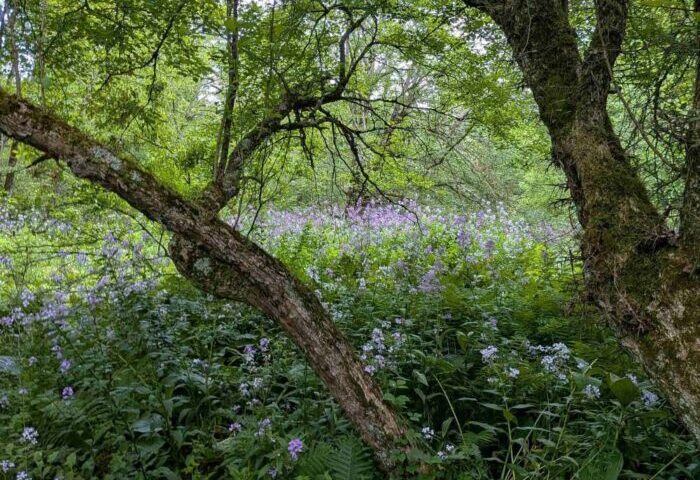
By the spring of 2020, the land preservation process was in full swing, and CPC staff were documenting the natural and scenic qualities of the land to demonstrate its numerous public benefits to public and private funders. Though remote, every day thousands of drivers on the PA turnpike enjoy scenic views of the property from the western end of the Kittatinny Mountain Tunnel. From there, the property can be appreciated as part of the forest-blanketed Rising Mountain to the northeast, past the bucolic scenery of Amberson Valley. Hikers and backpackers may know the property better as part of Section 5 of the over 250-mile Tuscarora Trail. Located approximately three and a half miles south of the Hemlock Road parking area, the closest means of access for day-hikers, the Trail follows the length of the northern property boundary for roughly half a mile before connecting to another local trail of interest: the Catholic Path.
According to Doylesburg historians, the Catholic Path was cleared by pious settlers of the Amberson Valley in the late 1700s as they hiked over Rising Mountain every Sunday to hear mass from a traveling Catholic Priest in Doylesburg, PA. Today, the storied Path serves mainly as an alternate route for outdoorspeople hiking Section 5 of the Tuscarora Trail, which is a notoriously waterless section for thru hikers. The alternate route is coveted for its detour down the forested slope of Rising Mountain and over Fealty Steward Run, the sole water source available to backpackers of this section.

Despite their inclusion on trail maps and brochures, neither of the trail segments described above are completely preserved with formal protection. Instead, trail use has been enabled by a long history of handshake agreements between trail users and landowners; agreements which, unfortunately, last only until the land changes hands once again.
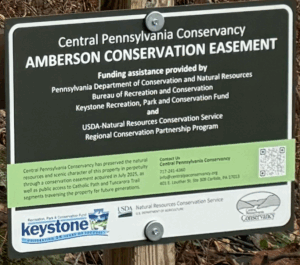
In the Summer of 2025, this cyclic uncertainty of legal use and enjoyment of the trails was brought to an end by the generosity of the Parrish family, the conservation expertise of CPC, and the financial support of numerous private and public partners. Through partnership with these groups, CPC was able to acquire a perpetual conservation easement to secure public access to both the Tuscarora Trail and Catholic Path on the property while also requiring sustainable management of forest resources by current and future landowners.
From the beginning, the intentions of the landowner were clear. “By granting the easement to CPC, we permanently ensure access to a portion of the Tuscarora Trail and the historic Catholic Path,” said Amanda Parrish. “The access will encourage more people to get outside, enjoy nature, take a deep breath, and a beautiful hike. There are so many benefits to spending time in nature, and we are excited to be part of CPC’s work in this location.”
The conservation partnership, which enabled this project, was largely due to the exemplary conservation values of the property, which attracted the support of three key groups: the USDA Natural Resources Conservation Service, through its Resource Conservation Partnership Program; the PA Department of Conservation and Natural Resources’ Bureau of Recreation and Conservation, through its Community Conservation Partnership Program, which is funded by the Keystone Recreation, Park and Conservation Fund; and the Mountain Club of Maryland through its Miles Fund. The support of these funders, combined with the landowner’s commitment to preserving the property, is an excellent example of what conservation success is possible when private and public partners collaborate.
About Central Pennsylvania Conservancy
The Central Pennsylvania Conservancy is a member-supported, nonprofit land trust formed in 1982 with a mission to acquire, preserve, and protect land and natural resources in south central Pennsylvania. As a nationally accredited land trust, CPC strives to meet and exceed best standards and practices for protecting important natural places and working lands in perpetuity, including sound financial management, ethical organizational conduct, responsible governance, and lasting stewardship.