

by Greg Podniesinski
In recent years tropical passion fruits (usually the tropical passionflower, Passiflora edulis) have begun to appear in grocery produce sections and passion fruit flavoring has appeared in many beverages. This exotic fruit is often associated with tropical regions but has cousins that happily reside right here in Pennsylvania. The passionflower genus, Passiflora, has about 550 members worldwide, with the majority in tropical and subtropical South and North America, and includes our two Pennsylvania species, yellow passionflower (Passiflora lutea, PA Endangered, native) and purple passionflower (Passiflora incarnata, PA native or introduced).
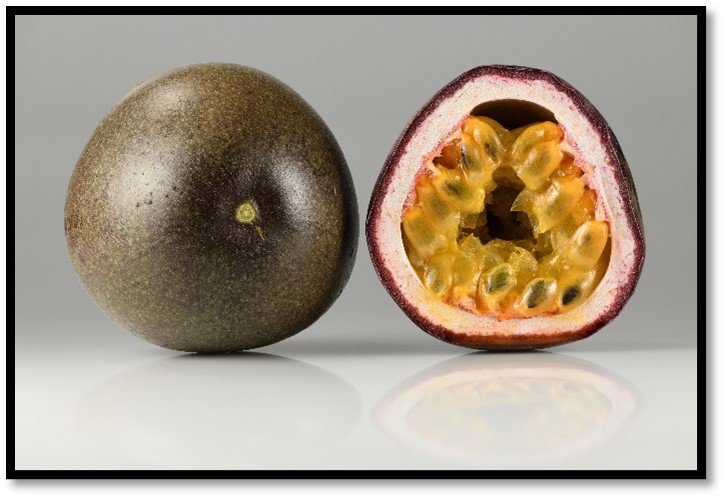
Tropical passion fruit, Passiflora edulis, the variety found in grocery stores. Photo by Ivar Leidus is licensed under CC BY-SA 4.0.
Interestingly, the common name “passionflower” does not refer to romantic passion but rather stems back to 15th and 16th century Spanish Christian missionaries in the New World, who symbolically related the passionflower flower parts to aspects of the crucifixion of Jesus Christ. Later in the 18th century, the “father of modern taxonomy”, Carl (Carolus) Linnaeus, referenced the origin of the common name, giving the passionflower genus its name “Passiflora”, which in Latin literally means “suffered flower”. In other parts of the world, the common name is less dramatic as it’s referred to as the “clock flower” in both Greece and Japan, presumably based on its radial symmetry.
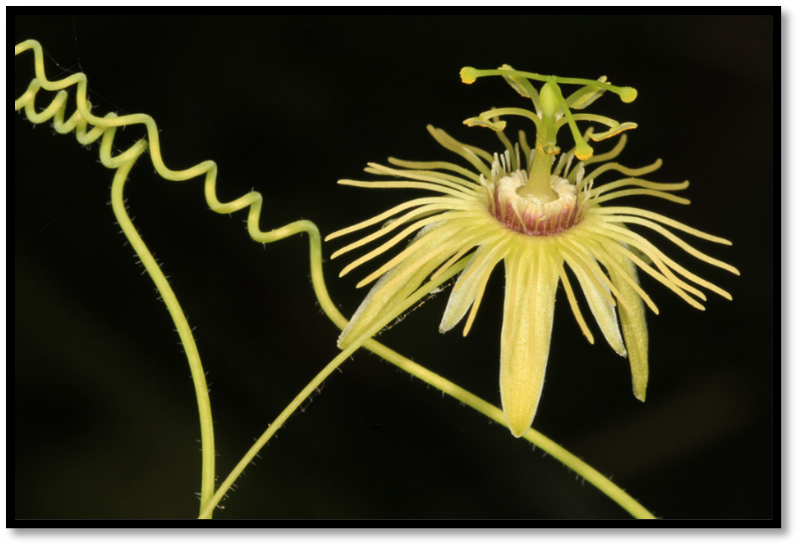
“Yellow Passionflower – Passiflora lutea, Occoquan Bay National Wildlife Refuge, Woodbridge, Virginia” by Judy Gallagher is licensed under CC BY 2.0.
The yellow passionflower is the most cold-tolerant passionflower, edging slightly further north than the purple passionflower, making it into southwestern PA. It’s range in North America extends west to Kansas and south to Texas and Florida. The yellow passionflower is less dramatic than some other passion flowers, being a pale yellow, but still has the dramatic architecture of the genus. The flowers are used by a wide variety of pollinators, including hummingbirds, butterflies, and bees. While the small black fruit is consumed by mammals and birds, it’s not considered edible for humans due to its very bitter taste.
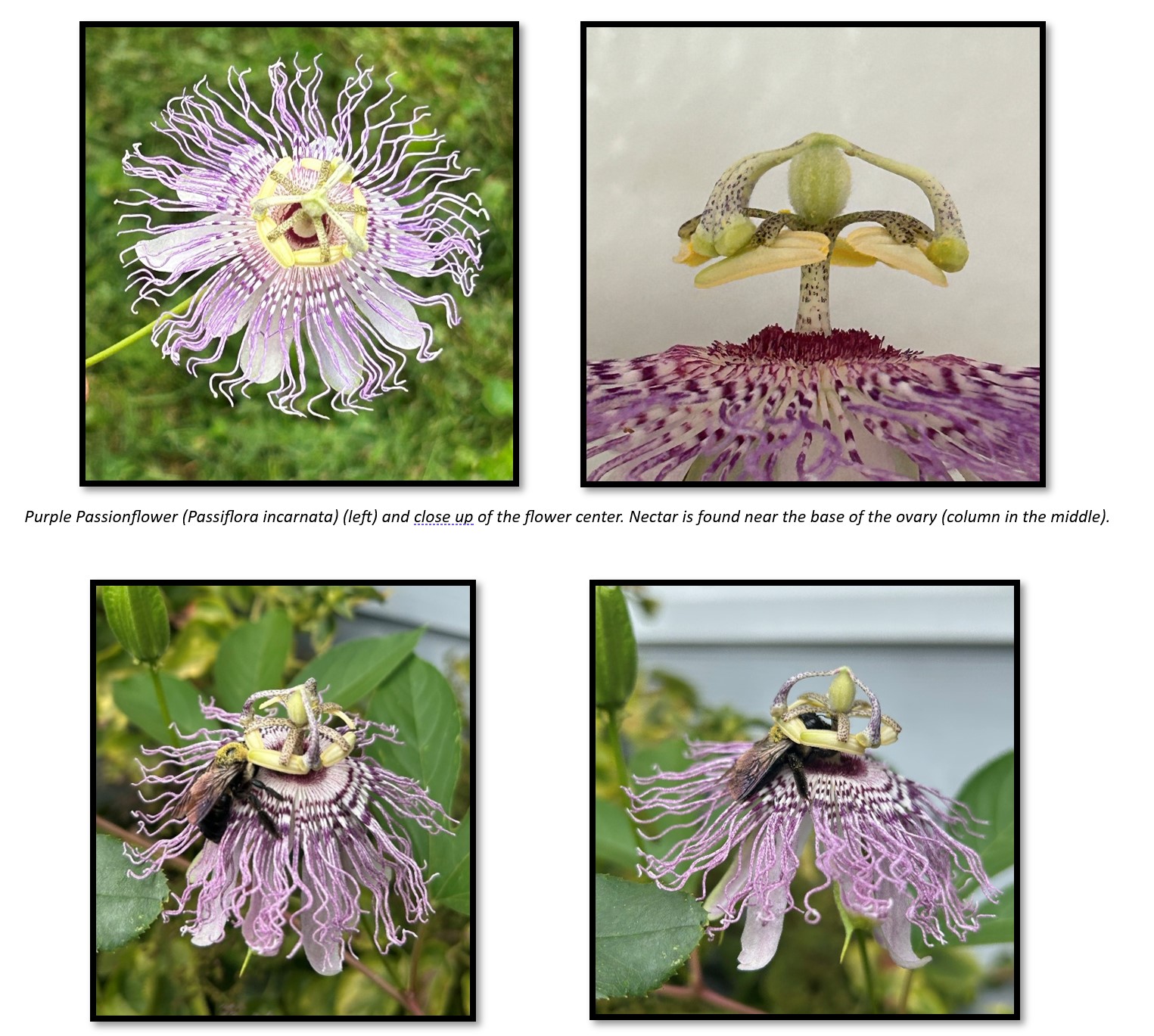
The purple passionflower (also known as maypop) is at its northern limit in Pennsylvania, with some debate over its nativity within the state. Most sources give its native range as Maryland and Delaware, south to Florida and west to Texas and; with a warming climate, it may be spreading north into Pennsylvania on its own (it’s very happily growing in my backyard). The alternative name, maypop, stems from the popping sound the partially hollow fruit makes when crushed (I have not tried this yet!). It’s also a bit more colorful than yellow passionflower, with a mix of white, bluish-purple and pale-yellow flower parts. Like the yellow passionflower, the purple passionflower is visited by a wide variety of pollinators.
Carpenter bees are fond of passion flowers. Above, one lands on a flower and then forces it way underneath the floral structure to reach the nectar in the center and in the process, scrapes pollen off the overhanging stamens, which are caught on the hairs on the back of the bee.
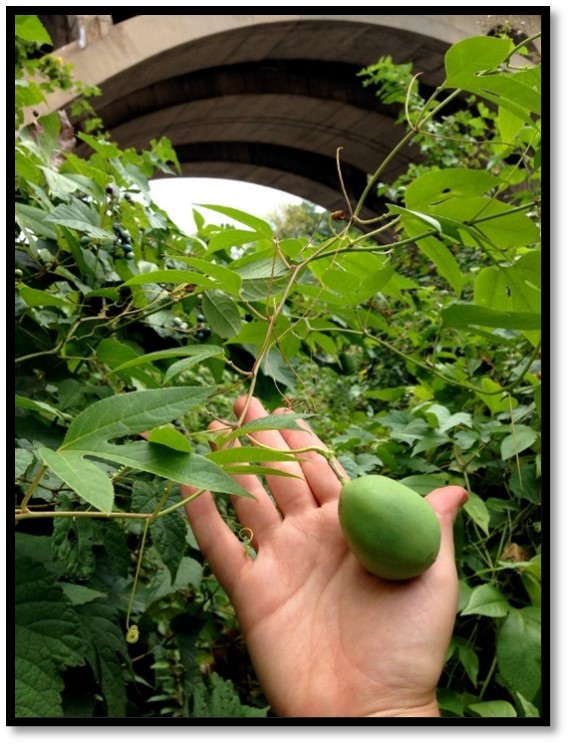
Immature purple passionflower fruit. Photo by FritzFlohrReynolds is licensed under CC BY-SA 2.0.
Like its tropical cousins, purple passionflower fruits are edible, with a flavor described as having a sweet and tart taste like an apricot. When mature, the fruits are about the size of a hen’s egg and take on a yellow-green to yellow-orange color. The jelly-like flesh appears a dull yellow when ripe. The fruit can be eaten fresh, used in jam and desserts, and can be juiced and used to flavor drinks.
The yellow and purple passionflowers naturally occur in moist to wet habitats but are adaptable and can also occur in drier, disturbed habitats, hedgerows, forest edges, and thickets. Available at some native plant nurseries, both species are relatively easy to grow and can be trained onto a fence or trellis. Both species spread through underground rhizomes and the climbing vines can reach up to 25 feet long. The purple passionflower can spread aggressively, so it may need some aggressive pruning in turn!